
The Fight For Naloxone
Whether you choose to view drug addiction as a disease, which it is, or as a moral flaw, which it’s not, there is no doubt that the opioid epidemic is a prevalent problem in this country. In 2016, 47,600 individuals died due to an opioid overdose in the United States. According to the National Institute on Drug Abuse, “every day, more than 130 people in the United States die after overdosing on opioids”. While our President too busy throwing tantrums over a wall that we do not need, the Food and Drug Administration (FDA) is taking some steps towards battling the opioid epidemic.
According to Kaiser Health News, the FDA is considering whether Naxolone should be co-prescribed with every opioid all across the United States. Naloxone—commonly known as Narcan—is a medication that reverses opioid overdoses. According to the National Institue on Drug Abuse, Naxolone can be given in three different ways: as an injectable that requires professional training, as an auto-injectable that can simply be injected into someone’s thigh, and as a prepackaged nasal spray. States such as California, Virginia, Arizona, Vermont, Washington, and Rhode Island already have laws enacted in which they demand that doctors either co-prescribe or simply offer Naloxone to patients they think may be at risk of overdosing.
Although requiring all states to co-prescribe Naloxone has the potential to save many lives, there are some flaws. Many doctors claim that it will be close to impossible for all states to enforce such requirements. Other doctors argue that Naloxone is useless for those who live alone.
Doctors aren’t the only ones who found flaws in the push for Naloxone. Patients who get prescribed Naloxone worry that they will get unfairly categorized as drug addicts. It turns out that a nurse from Boston who worked at an addiction treatment program was turned down from two life insurers because she had Naloxone on her, which she used for her patients.
Patients’ concerns with Naloxone emphasizes the stigma around drug addiction. Society tends to look at drug addicts as individuals who are morally flawed rather than individuals who are suffering from a disease. Addiction is not a choice. Addiction is a disease. Yes, the first time an individual uses a certain drug is a choice but they do not choose to become dependent on it.
According to the Center on Addiction, “addiction is caused by a combination of behavioral, environmental and biological factors. Genetic risks factors account for about half of the likelihood that an individual will develop addiction.” Addiction changes how one’s brain and body functions. No one chooses or wants to suffer from addiction.
I think making the co-prescription of Naloxone a national requirement would be a big step in the fight against the opioid epidemic. Although it has its flaws, I think it would make a difference. I believe that Naloxone has the potential to lower the number of lives lost due to an opioid overdose. Furthermore, society needs to take an even bigger leap and erase the stigma around drug addiction. We need to start treating it like it is a disease, not as something someone should be shamed for.
If you know anyone who is suffering from addiction, know that help is out there. You can call Substance Abuse and Mental Health Service Administration National Helpline at 1-800-662-HELP (4357), where they will guide you and give you the help needed.
– Sam
Sources: https://khn.org/news/more-states-say-doctors-must-offer-overdose-reversal-drug-along-with-opioids/
https://www.drugabuse.gov/related-topics/opioid-overdose-reversal-naloxone-narcan-evzio
https://www.centeronaddiction.org/what-addiction/addiction-disease
https://www.samhsa.gov/find-help/national-helpline
On the Politics of Kayfabe: How it Affects the News and How We Consume It
For most of you I have just introduced a new term by putting it in the title: ‘kayfabe.’ It’s okay, it was totally unknown to me too until a few months ago, though now that I know of it I can’t help but see it everywhere in media, and especially in our politics, so I feel it is my duty to introduce it to you fine folks. I’m going to put a link down below to a complete definition of kayfabe-but to sum it up, it’s a professional wrestling term that means to present something scripted or staged as real. I actually had a discussion with a compatriot among us a few days before this and it was brought up that this feels like just another way of defining suspension of disbelief, and to be fair it is hard to see a distinction. After all, with suspension of disbelief one is supposed to, for the time being, be able to take the reality that is presented to them from the media they are consuming and say to themselves, as they consume the narrative, that the world makes sense and that the rules remain consistent enough to follow. Once you’re thrust into “Star Wars”, there is a reality that you have to accept that audiences for decades have gotten behind wholeheartedly: the existence of faster than light travel, hard-light/plasma based weaponry, the existence of manageable extraplanetary government, and a mystical power born of a field of energy that surrounds all life. Hard to do if you were asked to believe these things existed in real life, easy to consider in a story. In a way, kayfabe works that way, not unlike the assumed fourth wall that exists between audience and stage during a play: what happens on stage is a reality we are expected to drop our normal pretensions for in order to allow ourselves to be immersed in the narrative. In a way kayfabe is very much like this, but it has one major caveat that sets up a very serious distinction.
Kayfabe and suspension of disbelief both as a kind of social contract, though suspension of disbelief is one that is one sided; the storyteller has to make a world that feels consistent, like the rules aren’t broken or bent too much, and that the narrative doesn’t contradict itself. In essence, he has to make something unreal, no matter how fantastical or beyond the limits of physical capability, feel real, but we don’t have to forever repay this feeling in kind. People don’t walk out of movie theaters or put down books talking about Hogwarts or Middle Earth as though it is a place we can visit tomorrow, not unless one is particularly young or of a particularly literal mind. We leave that mindscape and are able to consider it from our position of living in reality: we can critique, philosophize, deconstruct even. We can think about it as a piece of fiction, of being a reflection, facsimile, but not the genuine article. Kayfabe, however, is a two way contract, in that not only does it require the performers to not break character or the illusion that what is happening in their narrative is real, but the audience is not expected to do so either. There are families all across America that take WWE very seriously, where Monday Night RAW and Friday Night Smackdown are holy observances. Try to tell these people that it’s not real, that’s it’s all acting. Them’s fighting words in some households, in homes where to them it doesn’t if ‘The Rock’s’ real name is Dwayne Johnson, or that Kane isn’t a demon, it’s real to them. There have been breaks in kayfabe before, but there have even been controversies over whether such breaks themselves were staged and all really part of the grand performance, still talked about to this day even.
Professional wrestling has, for probably a combination of reasons, created a media culture that blends reality and staged narrative, where the facts of it being actors doing a staged performance is no longer the accepted reality, but instead the presented one of the being athletes competing at a great sport. For generations the currency of their realm isn’t factual fidelity, but emotional fidelity. In other words, if it feels real to you as an audience member, it is real. This would be a peculiar but harmless thing if it remained confined to this one form of media, but it didn’t, and it has reached a truly horrifying zenith. You can see it in so many forms, though no doubt most commonly in the form of celebrity feuds and relationships. Many of you have probably heard that most of them are staged for publicity and it wouldn’t exactly be far from the truth. In a video linked down below talks about one such feud, between Kanye West and Taylor Swift-it is the one that actually enlightened me to this phenomenon in the first place. It presents the example of how West put out a song a few years ago with lyrics that claimed that he had slept with Swift, much to her alleged outrage and condemnation. Later on, a recording came out showing not only Swift and West discussing this song, but her giving permission to him to continue on with the lyrics, in full contradiction of her later outrage, showing that the whole affair was simply an act to drum up publicity…and yet. Still, their relationship is still publicly known as having animosity, among their fans the status quo of them being at each other’s throats hasn’t really changed, and it seems this is mainly because the narrative holds more weight for them than the reality. If none of this horrifies you yet, well I haven’t introduced how it’s leaked into politics and news.
A particular part of the news cycle that has been around for a long while, but usually just always simmering on a low heat in the public consciousness, is the Mueller investigation. For those that aren’t aware, Robert Mueller is the special prosecutor who has been assigned by the Department of Justice to investigate the allegations of corruption amidst the 2016 Trump campain and possible collusion with the Russian government. Over many months this investigation has lead to arrests, indictments, confessions, and a whole lot of controversy and bluster. Folks on the right claim it amounts to nothing more than a witchhunt, while those on the left feel it’s the potential nail in Trump’s coffin. The truth is a bit more complicated, but to surmise the situation, it stands as a complex legal endeavor that has uncovered a lot of backroom deals and specially vested interests in foreign businesses and powers, mainly Russian, including meetings with potential Russian operatives.
To editorialize a bit, yeah it’s looking like they’re all pretty much guilty as sin. We’re pretty much just a few degrees away from the possibility that we may find evidence of Trump explicitly colluding with Russian operatives to influence the 2016 election. Will we find it? Probably not, if anyone’s smart in this, and there had to be at least one working brain among them. Is there enough to perhaps indict, maybe even convict anyone in the higher echelons of the cabinet on corruption or treason? Maybe, but not without probably some really damning evidence, the right judge, and most definitely the right jury. A lot of the evidence and potential witnesses remain confidential, and probably only a fraction has been released to the public. It is exactly this that has actually created the kind of political and especially news cycle climate that surrounds the investigation. From the media on the right there’s a constant narrative that Mueller’s investigation is without any substance, that in all this time, with no charges laid, no accusations even, that it must mean that it’s just one huge boondoggle. However, when one looks at it from the perspective of the subpoenas sent out, the arrests, indictments, convictions, and deals made, it looks more like they keep striking oil. Yet Fox News can always bring up the point of how little this is on their radar, how Trump hasn’t been served, how now trial date has been set. They conveniently forget to mention how it might have to do with the news they’re choosing not to report, the progression they don’t wish to acknowledge. It all creates a convincing story, especially when combined with the narrative they’ve been pushing since the election, one of how there are agents in the government who are specifically moving resources toward the effort of undermining the Trump presidency. Most horrifyingly, a lot of folks buy it, and it’s because to them it makes a lot of sense. In their news sphere they don’t hear about how Mueller has dug up so much dirt, and if they do it’s dismissed as overreaching and conspiracy. You could probably show them months of work and it wouldn’t make a difference. The narrative feels more real, and thus it is.
I talk about this because Mueller crept back into the news cycle in the last week. About a week ago it was talked about how Mueller May have been wrapping up his investigation. This could have been huge news, a game changer. A full report was possibly set to be written up, one that be confidentially presented to the Attorney General for consideration. That also became part of the news cycle, quite a bit actually, how the report would be confidential, and there being a desire for it to go public and the lengths that some would go to get it out there. Some even have claimed a desire to sue for it to be released. I guarantee though, none of that would matter to the public that still supports Trump. Public or no, they have made their decision. It really will all come down to what narrative you believe in, and Trump’s campaign and office have become very good at kayfabe. They have convinced a large base that they can build a wall, despite all evidence against it, and their are still plenty who are buying into it, regardless of fact. The economy has gotten better in some respects, and no matter how much evidence there is to show it is the result of the previous administration, this falls on a lot of deaf ears. Trump is the ubermensch who somehow turned the economy around in less than a full term, because that’s the better story, the story of a winner they’ve all bought into.
As it turns out, Mueller won’t be finishing his investigation, which leaves a lot more to be done. Paul Manafort is up on the chopping block, and that may prove fruitful. Only time will tell, but experience can sadly say a bit more for the future. The side that’s already posed to support Trump won’t see what the other side will bring forth. It offer some no narrative fidelity, and that’s tantamount to treason to them, treason to the reality they want, that they feel they need. Eh, at the least, now that I’ve told you about it, maybe you can look at this particular part of the news, if not the whole news cycle, with a fresh set of eyes. Just don’t fall into the same trap. It’s easy to put a story to fact, it helps make sense of things, put them into perspective. It also makes our ways of thinking dogmatic, clouding our judgment from further possibilities, or even what could be the best and worst of conclusions: that we’re wrong. That it’s just a story.
https://en.wikipedia.org/wiki/Kayfabe
https://www.vox.com/2019/2/20/18233483/mueller-report-trump-russia-next-week
https://www.theatlantic.com/politics/archive/2019/02/trump-mueller-report-smoking-guns/583336/
Mike R.
Hidden in Plain Sight
“One of the advantages of being disorganized is that one is always having surprising discoveries.”
―

“Ultra-rare black leopard is photographed for the first time in 100 YEARS in Africa,” the Daily Mail trumpeted.
“African black leopard photographed for the first time in over 100 years, scientist says,” CNN said.
These and similar headlines recently could have been spotted (ha) circling around the internet. Exciting most and confusing a number of people, the articles detailed an extraordinary discovery that in the end proved false. As can be read in a brilliant article by Reis Thebault & Alex Horton in the Washington Post, this was actually “the first time in nearly a century that photographic evidence documented the rosette-patterned-speckled coat of an African leopard, confirming existence on the continent of the genetic mutation that makes black leopards, well, black.” And so, while it may not be the grandiose discovery that various media outlets proclaimed it to be, it’s still important to both the scientific community and to photographer Will Burrard-Lucas, whose long-time dream of capturing the elusive creature of myths and legends came true when he least expected it to.
However, for those of you out there in need of something that could possibly fill that jagged hole left from when the truth was revealed, below you can find several other recent discoveries that are sure to dazzle and amaze.

It was thought that more than 100 years ago the Fernandina giant tortoise, a species of tortoises found on one of the Galápagos Islands, had gone extinct, as the last confirmed sighting of the species was registered in 1906. A few years ago, signs of the tortoise being still present on the Fernandina island were acknowledged and its status was updated to ‘critically endangered.’ That is, until now. Enter female specimen, roughly 100 years old, found by Washington Tapia and his team nestled on one of the green patches of the island on February 17th, 2019 (see above image). And as National Geographic writer Jill Langlois explains in his article (click here to go read it in full): “Tapia and his team do expect to find more. During this search of Fernandina, they came across more tortoise tracks in soil just over a mile from where they discovered the female. The team is planning another expedition to the island later this year.” Can you believe it?
Remarkably, the Fernandina giant tortoise is not the only species to have turned up alive and well in this past month:

Clay Bolt
In her article, “Scientists thought they lost the world’s largest bee, but it was hiding in plain sight,” Eleanor Cummins addresses an important question:
How does one lose sight of a 1.5 inch-long bee species with a 2.5 inch-long wingspan and mandibles that would make even the meanest wasp quiver?
It turns out has easily as misplacing your keys. After its initial discovery in 1859, and around the 1980s the bee had been thought to have disappeared off the face of the planet. It was not until recently, on February 18th, a specimen was seen and caught for preservation by etymologist Adam Messer in the bee’s new natural habitat on Indonesia’s North Moluccas islands.
Think giant bees are easy to spot? How about giant caves?
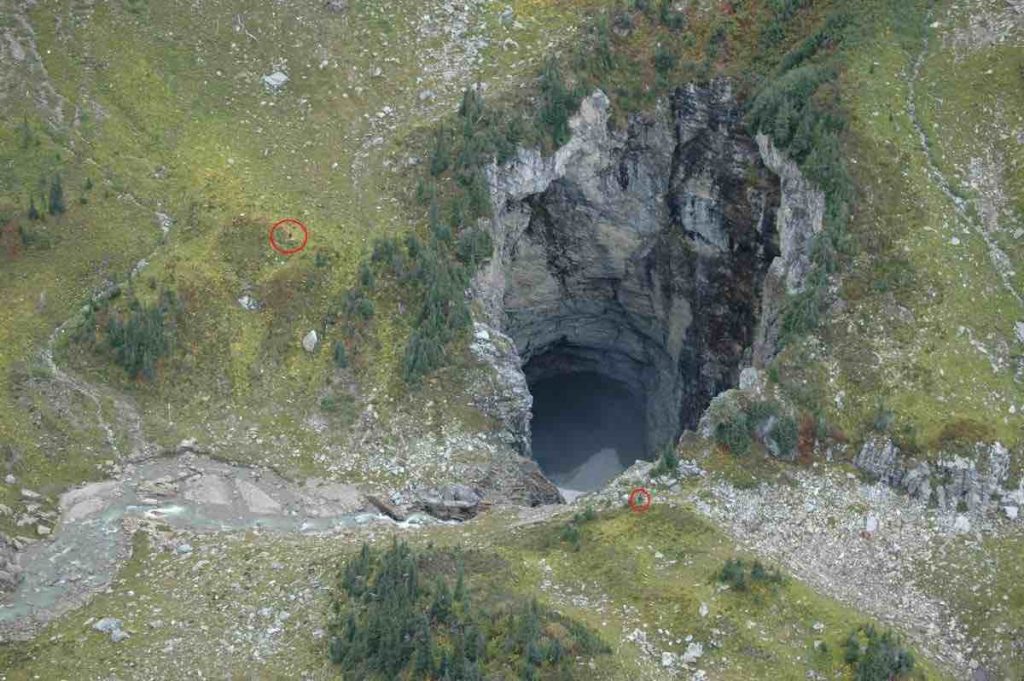
“A “honking big” cave has been discovered tucked away in the rugged Canadian landscape – and geologists are in awe of its magnitude.
The cave, which is located in British Columbia’s Wells Gray Provincial Park, was first spotted by researchers when they were performing a routine caribou survey by helicopter. From their air-borne position, it looked like a black hole amidst a sea of snow.” (full article can be found here)
How could we miss that abyss for so many years? You would think it would be impossible, like something from a Jules Verne novel! And here we are just stumbling upon it now, and already gearing up to explore its all-consuming depths.
Finally, remember when there were nine planets? When Pluto was discovered and Disney named a yellow cartoon dog after it? Well, it’s possible we could experience all that again with this news:

As Mollie R. Simon of the Greenville News writes:
“During his lecture [at the Clemen Univeristy last week], Brown — the self-proclaimed “Pluto Killer” — did not focus on the planet he doomed from elementary school textbooks but instead told a story of a new discovery.
Brown explained how the interesting orbits of two planetary objects named Sedna and Biden led him to predict the existence of a true ninth planet, six times the size of Earth.
Working backwards like a forensic investigator, Brown and other researchers hypothesized that the orbits of Sedna and Biden might be the result of a massive planet. Using computer simulations, they decided the theory had merit.
“It is really quite easy to come up with an explanation for some set of phenomenon, and planetary scientists for 150 years have been using planets as an explanation,” Brown said. “We didn’t want to be just another set of people saying, ‘Uh, there must be a planet,’ because it seemed really unlikely.”
That initial caution gave way to more research.
Brown projected that if there really was a massive planet, it would have a set of objects in perpendicular orbits around it. When he modeled where those would be, he found six known objects perfectly aligned with his projection.
“This is when my jaw hit the floor,” Brown said. “This is where it went to, “Oh my God, there’s a planet out there.”
While no planet has been spotted that matches Brown’s discovery, he believes it is a matter of “when” not “if” it will be found.
Words cannot describe the excitement and wonder one feels when they read these kinds of stories; new species, caves, and underground caverns yet to be explored being found every so often, old species proclaimed extinct but in actuality still hanging in there, or planets hiding in the vastness of space. And then you read about the species we lost either due to climate change, or pollution, or trophy hunting. Species that you probably never knew existed and mattered to the eco-system gone without any chance of reviving (or, at least, until people get ahold of that new-fangled technology that they had in Jurassic Park). It’s great that these discoveries are being made, however, alongside them, we should also remember to acknowledge the extraordinary accomplishments of scientists and even ordinary people who are creating solutions to healing our planet and saving the habitats of many species, including our own.
-L.L.L.
Judge, Jury, and Executioner
Imagine your teenage self making the conscious decision to flee your home country and join a terrorist organization. Would you consider yourself accountable? Or would you claim that you were too young, too sheltered, and too impressionable to make a properly educated decision at the time? This sentiment of naivety is one that many foreign-born brides of terrorist organizations make in their pleas for admittance back into their native countries. One of these women, Shamima Begum, now makes a similar plea to implore mercy from the UK where she was raised.
Begum was just fifteen years old when she left Bethnal Green, London to join ISIL. She was accompanied by her friends Amira Abase and Kadiza Sultana. She married within several weeks of arriving to Syria and bore three children over the course of four years. Two of those children died. The third child was born this February in a refugee camp. Before the birth of her son, Begum openly denounced the UK and praised ISIL despite its numerous atrocities, crimes, and egregious human rights violations. With the birth of her third child, however, Begum began to express regret in her decision, claiming that if given the chance she might serve as a public example of how one can change and deter young, impressionable girls from making her mistakes.

This desperate plea to be admitted back home is in its nature problematic, made even more controversial by the fact that, as of this month, she will no longer considered a citizen of the UK. This move made by Sajid Javi, Home Secretary of the United Kingdom, essentially eliminates any chance of Begum’s return home. Her plea is based mostly around the belief that her decision to join ISIL was a folly made by a young girl and that her son needs protection unavailable to him in the refugee camp they she now live. This appeal to naivety and protection for her son has led to avid debate about her intentions and the mercy of the British government. One side supports the idea that she was a victim of ideological propaganda, the side claims that her return to the UK would endanger the state and make it vulnerable to an extremist threat. Even her family has weighed in on the debate, supporting the government’s move to eliminate her citizenship but begging for the return of her child.
It is an emotionally and ideologically difficult decision to consider. Should we grant a member of a terrorist organization clemency or, at the very least, the opportunity to amend their mistakes? Is the age at which an individual makes a decision relevant if they make no effort to rectify it as they mature? Where is the line drawn between being impressionable and being a threat to others? Is the life of an innocent child a government’s responsibility even if that child was born in a foreign state?
Shamima Begum is one of many to join a terrorist organization only to later regret her decision. Is it for us to say what she deserves? Who is to say, if she should live with the consequences of her decision, or if she should be allowed to right her wrongs.
 The Junction Journal