
As a little girl, I was obsessed with old Hollywood actresses. From Marilyn Monroe to Veronica Lake, I was completely taken by how these women constructed entirely new public images of themselves to advance their careers. This idea that I could renounce my awkward seven-year-old self and become a glamorous movie star greatly appealed to my childhood need for attention. So at ten years old when my father introduced me to the works of Andy Warhol, I was sold.
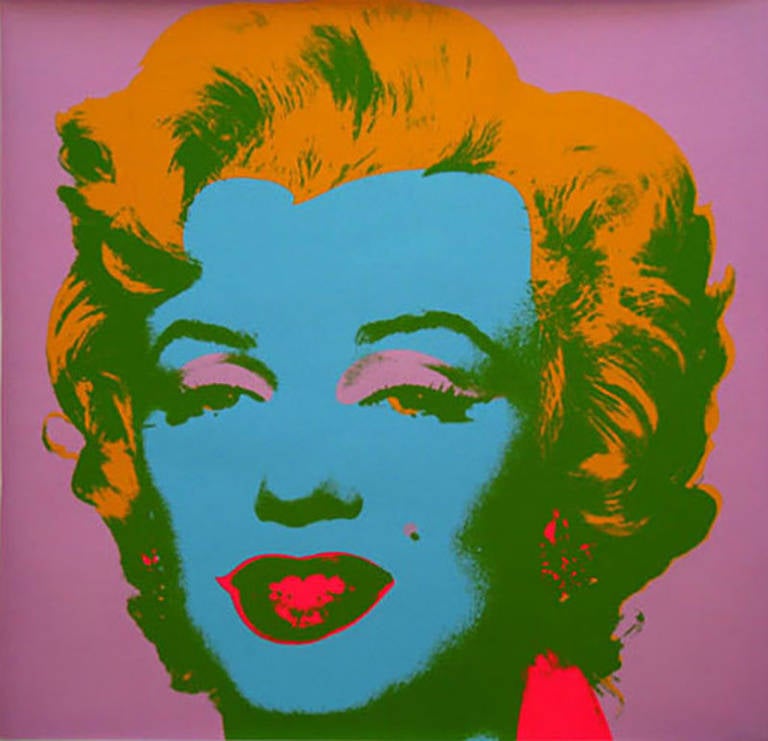
Andy Warhol, Marilyn Monroe (Marilyn), 1967 Screen Print on Lenox Museum Board (F&S.II.28), orange hair and blue face (source: Artetrama )
First of all, his quotes are epic. Second, his artistry is a visible demonstration of how art can turn the pitifully awkward into the admirably eccentric. His art, starting from the 1960’s, was intended as a reflection of America’s mass production boom and its every growing fascination with Hollywood stars.
“I love Los Angeles. I love Hollywood. They’re beautiful. Everybody’s plastic, but I love plastic. I want to be plastic.”
This quote from Warhol is emblematic of the construction of public image that Warhol sought to replicate in his art. In many ways, he tried to extend the liberating notion of building the self one desires against the self that an oppressive society dictates one should be. In other words, he rejected the exclusivity that the Hollywood elite had in forming their own image, and brought it to the masses.
Fran Lebowitz, a former writer for Warhol’s Paper magazine, states in her documentary Public Speaking: “Andy made fame more famous.” In her documentary, she explains that Warhol would take drag queens, dress them up as movie stars and photograph them while proclaiming them “Super-Stars!” At the time, cross-dressing was illegal in New York State, and Lebowitz claims that this proclamation was intended as a joke. However, I do not take this as a joke at the expense of drag queens, but rather, a joke at the expense of a society which so constructs these illusionary and divisive gender roles.
His artwork’s mission to disassemble exclusionary privileges is apparent in his artwork of common American products.

Andy Warhol, Green Coca-Cola Bottles, 1962
“What’s great about this country is that America started the tradition where the richest consumers buy essentially the same things as the poorest. You can be watching TV and see Coca-Cola, and you can know that the President drinks Coke. Liz Taylor drinks Coke, and just think, you can drink Coke, too.” -Warhol.
However, taking aside the brilliant deconstruction of privileges and luxuries that reinforce the separation of social classes, Warhol’s attention to democratizing fame and attention has reinforced a culture where fame matters. It has become a valuable source of currency within this culture in order to advance one’s position. We even have a reality TV star as president of the United States. Making the concept of fame more famous helped cultivate a culture where fame became valued above character and integrity. In today’s culture, the most influential people in our world are able to maintain their positions of power as long as they maintain the semblance of being popular and being liked.
So yeah, I hold Andy Warhol and his artwork accountable for all that is right and wrong in America.
 The Junction Journal