
“Odutola’s To Wander Determined: An Exploration of Black Identity and Subjection”
A new portrait series at the Whitney Museum is stirring the ever-perplexing discourse surrounding black identity and demanding of viewers answers to these questions: what does it mean to be a subject? What does it mean to be black? What does it mean to be subjected to blackness?

This past Friday, my boyfriend and I visited the Whitney for our anniversary and experienced the wondrous project that is Toyin Ojih Odutola’s series To Wander Determined.

Toyin Ojih Odutola is a 32-year-old Nigerian-born artist living in New York who “creates drawings utilizing diverse mediums to emphasize the striated terrain of an image and its formulaic representations.” Since the early 2010s, her work has been featured in numerous galleries and exhibitions, including the MoMA, the National Museum of African Art (Smithsonian), the Brooklyn Museum, and now the Whitney.
Odutola’s work has become quite prevalent, having been featured in disparate mediums such as poetry (Claudia Rankine’s Citizen) and television (Empire, see video below), reaching the likes of celebrities like Solange, who is a collector.
To Wander Determined continues her ever-growing legacy. Curated by Rujeko Hockley and Melinda Lang, Odutola’s sprawling new exhibit stands in its own corner of the Whitney, isolated by white walls that almost struggle to contain her often lusciously colorful and sumptuous portraits. Many of the works and the frames that contain them tower above the observer, the subjects shimmering against the varied backdrops, almost testing the observer with their jaded, judgmental gazes.
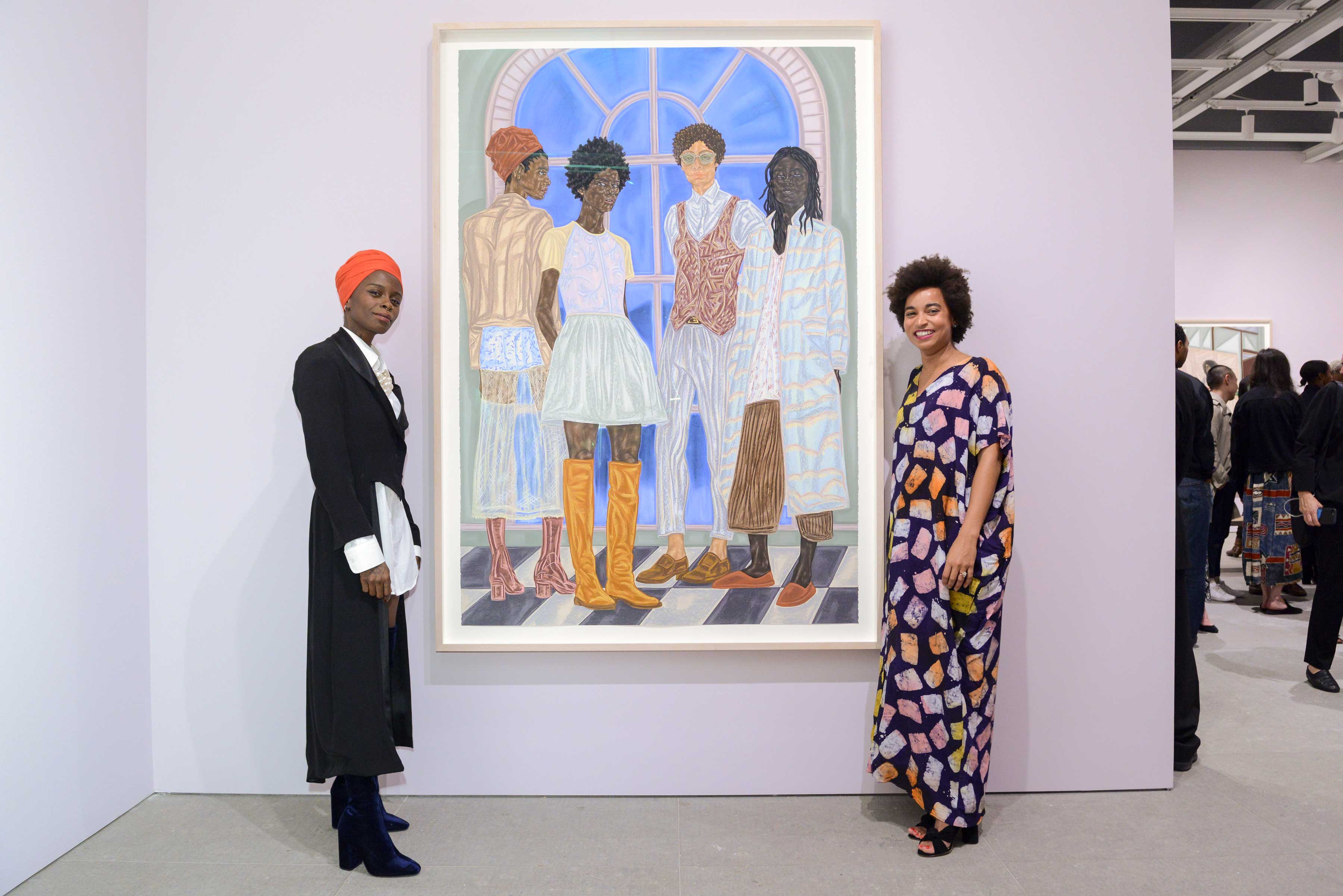
Each portrait is deliberately enigmatic. And the subjects do little to help us understand anything about them other than the fact that they carry worlds behind their tired eyes. All we know is that these figures, according to a plaque (pictured below) are members of two fictional Nigerian noble families. We can see this in the distant, regal stares in many of the portraits, as well as the high-brow locations. In an interview with Vogue, Odutola confesses the ways in which she uses these very specific yet vague parameters to destabilize our normative perception:
When I started this whole series, I had an outline. I knew the characters, their stories, their backgrounds. I had this whole family tree. That didn’t need to translate to the audience. I wanted to frame it in a way that feels like a panel from a graphic novel: You’re just walking into that story; it seems disorienting. It seems like I need more context to explain this picture. But the picture as it exists explains enough. I had to fight the knee-jerk reaction to add more. I like the idea that people can decode a picture, but not in some way where they need to figure out why this guy is wearing a vest that looks like it’s from the 1920s, or why this woman is dressed like she’s from the ’40s. The point is more about why your imagination doesn’t even assume this in the first place.
In every aspect of these paintings, Odutola plays with our expectations as American viewers. Representatives of State features four young, stylish black women as its titular figures, an image totally in contrast to global perceptions of authority. Wall of Ambassadors similarly empowers black women in positions of governmental power. In Pregnant (pictured below) the woman depicted looks anything but, and instead of the traditional narrative of a glowing mother-to-be, we are greeted by a hardened, apathetic subject, almost sexualized in her see-through skirt, her skin fluorescent, contrasted by the muted white wall behind.

Her work also challenges us to look further than the surface level. Between The Margins (pictured below), has an appropriate title. It stands out to me personally as the most provocative and challenging of the collection. The more I look at the subject, the more I see myself and the less sure I become of what that means. The longing in his eyes, the story within them and without them, the subtle details of his garb, his hair, and the field beneath him; it grabs me as much as it pushes me away. I wandered determined, and I left with more questions.

Odutola’s expansive collection is open from October 20th of this year until February 25 of 2018.
-Isaiah Rivera
 The Junction Journal