
The Future of Medicine
The Food and Drug Administration recently approved a digital pill that contains magnesium, copper, and silicon and allows your doctor to monitor your medicine intake. By attaching a patch and syncing with Bluetooth, the doctor is notified with the time and date of ingestion. The patient also has the ability to add notes about their health. While the pill’s ingredients are non-harmful, some are uneasy about digesting technology and its negative impact on privacy. 
The digital pill would help address the overdose epidemic, by warning the doctor of any unusual intake. It would also help with individuals suffering from psychological disorders who are more likely to miss doses and relapse. Abilify is the first antipsychotic to be approved and some are doubtful about the helpfulness of this digital drug. Many patients with schizophrenia, depression, and bipolar disorder already suffer from paranoia and having a doctor ‘watch’ your behavior would only heighten this sensation and prevent the patient from taking their medication. While its practicality for psychological disorders is uncertain, it seems more promising for individuals in rehabilitation. It may also become a requirement for parole, thereby securing a commitment to prescriptions.

One of the largest ethical concerns about merging technology with medicine is whether ‘Big Brother’ will be watching. With technology like our phones, the Alexa speaker, and the Internet, we are constantly bombarded with suggestive ads based on our searches, which store data. Some fear that with this kind of access, the government will also be able to monitor our activity and privacy will become obsolete.
There is also the danger with any technology, that hackers can receive our personal information, including prescriptions taken. With prescriptions like pain relievers, having this access is especially harmful as the market and price of obtaining these pills rises with the overdose count. By having information transmitted through bluetooth, apps, and the Internet, does this break a sort of patient and doctor confidentiality? If then, where does our trust in our doctors lie, between the numbers of codes? Also, will pharmaceutical companies be able to promote other drugs to us, in the same way cookies send us related ads?

Perhaps the most pressing issue is the way medicine and health care are tied to capitalism. With an increase in medicines but not enough cures, some wonder whether our health care’s primary interest is actually in the patient or in profit. The price of this new drug is not listed yet but there may be an incentive for taking it, by offering lower copayments. Is this really ethical? How do we provide health care for those who cannot afford it?
While I am not surprised the FDA approved the digital pill, considering their lax supervision on the harmful ingredients in food like children’s cereals and snacks, I am worried about the power of technology. Sometimes I want to unplug from our technological attachment, but this is becoming increasingly difficult. This drug also raises serious ethical concerns and distances the actual care for the patient.
Source:
-Stephanie Montalti
Don’t Cross Her: A Stranger Than Fiction Crime Story
In a bizarre story straight out of a bestselling domestic thriller by Gillian Flynn or Paula Hawkins, a local Staten Island chiropractor, Danielle Serini, will be exonerated of numerous false charges made against her this past year after being framed by Jennifer Becker, a local crossing guard.
According to reports, the two began a feud in June of last year outside of P.S. 29 and St. Theresa School, where Becker was previously a crossing guard. Allegedly, a series of altercations occurred between the women where Serini spat at Becker, called her an expletive and flipped her the bird, leading Becker to obtain an order of protection against Serini. These charges came to a head this past February when Serini was accused of more middle finger action, sticking her tongue out at Becker, and, perhaps most absurdly, tossing a lollipop at her.
A few weeks after these developments, over a dozen letters were sent to the 120th Precinct, the contents of which were racist, vulgar and violent. One made reference to the Ku Klux Klan and depicted a black child with razor blades shopped into their head; another showed a black child hanging from a noose. The letters contained bigoted language such as “I HATE BLACKS ALMOST AS MUCH AS THEY HATE ME,” one of which was addressed to a presumably Muslim crossing guard, “TRUMP BETTER DEPORT YOUR STUPID A– FOR TAKING OUR AMERICAN MONEY!”
Detectives originally assumed Serini was responsible for these letters because they included threats to her accuser Jennifer Becker’s mixed race child: “My next opportunity will be getting rid of you and that ugly a– n—– child of the crossing guard. Keep thinking he’s safe in school. But when the opportunity hits, it will be bang, bang.” However, when new letters included Serini’s full name, detectives started to suspect something was off. Why would a maligned woman who had to close her business due to allegations against her, sign her own name on further incriminating evidence?
“It just looked too fake,” one source from the force claimed. “We started looking at it in a different direction and it started moving away from [Danielle Serini]. In the verbiage of these letters, obviously it wasn’t coming from this doctor.”
To further complicate matters, the letters also came with a scavenger hunt of sorts, a la Gone Girl. The officer who received many of the letters had received a package a few days earlier with Dum Dum lollipops with a note stating, “Clue 2.” Mere hours earlier, a crossing guard received the same package but instead had a note that said “Clue 1.” Again, straight from the bestseller list.
As more letters came pouring in (nearly two dozen), detectives decided to track who was truly sending these missives. Eventually they found a location where supplies for the mailings could be accessed, and they connected Jennifer Becker to that very location.
Becker was ultimately charged with one count of endangering a child’s welfare (her own no less), 4 counts of falsely reporting an incident, 11 counts of aggravated harassment, 12 counts of stalking, and 29 counts of tampering with evidence.
The judge also issued four orders of protection, including a family order requiring her to stay away from three relatives.
In the meantime, Serini hopes to salvage her professional reputation, while Becker awaits her next court date on December 11, before which she is ordered to receive a mental health screening.
And you thought Amy Dunne was bad.
-Isaiah Rivera
Down the Rabbit Hole
The allegations of sexual misconduct against Harvey Weinstein and Kevin Spacey have opened the proverbial can of worms on the entertainment and media industries. We’ve been creeping up to this point, slowly becoming more aware, and now the curtain has been ripped aside to reveal a grabby man in fancy clothes. Others in the industry suddenly find themselves in an uncomfortable spotlight as more people are coming forward as being victims of sexual harassment and rape – Al Franken from PBS is being “removed” from his job, comedian Louis C.K. is following suit, and a quick google will bring up tens of others names being called out.
It isn’t a secret that the entertainment industry tends to be a breeding ground for sexual misconduct – the objectification of both women and men is one of the dirty pillars in Hollywood’s basement, and in an industry that’s swarmed with hopefuls and desperate dreamers, it’s simpler to keep your mouth shut. I remember actress Jennifer Lawrence talking in an interview about having to strip down to her undergarments with another group of women in front of a producer and being too young and naïve to know how to say no. A lot of people want to believe that this isn’t our Hollywood, not our new and modern Hollywood. But it is. And it seems that we’re finally ready to say, no.
And it’s not only here – in France, the public seems split. An article I recently read explains:
In further resistance against calling out sexual misconduct, Roman Polanski, a film director who pleaded guilty to drugging and feeding alcohol to a 13-year old girl and then having sex with her, was defended by the French Minister of Culture and honored as president of the Cesar awards. Their excuse was that their role was not to “moralize.”
While I am disgusted by the honoring of a convicted rapist, I do understand the dilemma from a base point: at what point does the person and his work become one that we can no longer separate? Do we have to first look at the creator of every morsel we enjoy before we put it in our mouths? T.S. Eliot was a known anti-Semite, yet I have the first forty-five lines of “The Love Song of J. Alfred Prufrock” memorized.
But I think we have to put this in perspective. We are at a point right now where we need to weed our garden before it kills everything surrounding it. You can say you are honoring Polanski’s work and not his person a million times but the message you’re putting across is that it’s okay. We are in a time right now where we could actually set some things right – people are coming forward and others are stepping down because it’s really, truly, not okay. This is not philosophizing about authors long dead and their legacy. This is about people who are here and now, sexual predators who will keep going if they don’t get caught. This is about calling out someone who might create another victim tomorrow and the day after that, and the day after that.
-Merav
Profile of a Revolutionary

Under house arrest and flanked by the very generals who had placed him there, the ninety-three year old president of Zimbabwe, Robert Mugabe (seen left), gave an address to the nation on November 19, 2017, where he was expected to formally resign from office. In a slow and slightly slurred speech, occasionally adjusting his round glasses, preventing them from slipping off his nose, the shuffling of his papers adding texture to the mic’s natural static, Mugabe patiently acknowledged the military’s concerns and politely declined their invitation to resign from the office he’s held with an iron grip for the last thirty-seven years.
Born in 1924, Mugabe grew up in what was then called Rhodesia, a nation suffering under British colonial rule. Educated by Jesuit missionaries, Mugabe was inspired to be a teacher by Father Jerome O’Hea, an Irishman who preached racial equality and inspired his student with stories of the Irish War of Independence (1919 – 1921) which successfully resulted in the overthrow of British rule. Studying to be an educator, as a young man Mugabe explored the nations bordering Rhodesia where he met Jewish South African Marxists, learned about Gandhi’s independence movement in India, and took inspiration from Ghana, the first African state to be independent of European powers.
Alongside his Ghanaian wife, Sally Hayfron, Mugabe returned to Rhodesia as a committed African nationalist in the 1960s, as well a Marxist revolutionary. Respected in his community due to his travels and numerous degrees, Mugabe initially sought an independent state that was led by the majority black population. However, his rhetoric grew more and more extremist as he supported armed resistance against the ruling white minority, coming to see that as a necessary tactic to rid Rhodesia of British colonial rule.

As activists, both Mugabe and his wife (seen left) were in and out of prison during this turbulent period. After the birth of their son, Mugabe insisted his wife go to Ghana with their child while he remained fighting for independence in Rhodesia. Imprisoned there for inflammatory remarks against the government, Mugabe received word in 1966, that his three year old son had died. Though he asked to be able to attend his funeral in Ghana, the request was denied. A decision Mugabe never forgave the prison authority for.

Released from prison in 1974, Mugabe recommitted himself to overthrowing colonial power. As the head of the Zimbabwe African National Union (ZANU), he waged a successful guerilla war against the ruling white minority which ultimately led to the dismemberment of the Rhodesian government under Prime Minister Ian Smith (seen below). Elected Smith’s successor in the 1980 general election, Mugabe served as Prime Minister for seven years. He renamed the country Zimbabwe, tearing down statues of colonial figures such as Cecil Rhodes (whom his British South African Company named Rhodesia after – seen right) and replacing the names of roads and buildings with those of black revolutionaries.

These seven years did not see the promised transition into a socialist state which Mugabe had consistently infused into his rhetoric. It did see a lot of support from western nations (including the United States and United Kingdom) who offered aid in the form of funding and military advisement in the hopes that the effects of a stable and prosperous Zimbabwe would trickle out through the region (in particular, South Africa, which was transitioning from apartheid in the early 90s). Under Mugabe’s leadership, Rhodesia also saw a significant rise in literacy and immunizations, but was dogged by an expanding web of corruption which saw the new ruling class of elite blacks gaining more and more wealth while most of the nation was in poverty.
Adding to this, there was a mass exodus of white Rhodesians who were none too thrilled about a black Marxist running the country, especially since Mugabe had often preached massacring the lot of them as a tactic to overthrow colonial rule. Though Mugabe tried to walk back his previously inflammatory comments in order to maintain a lot of the nation’s wealth which was still tightly encased by the small white community, half of the white population fled to South Africa, creating an economic pitfall for the country. Mugabe later accused terrorist attacks against himself and his party as being enacted by South African-backed white militants, and again accused Zimbabwe’s neighbor of secretly backing Ndebele rebels in his country.
The guerrilla war which Mugabe’s political party ZANU had waged against Prime Minister Ian Smith’s government in the 70s had not been a two-sided war. Also a participant was the Zimbabwe African People’s Union (ZAPU). Though both ZANU and ZAPU wanted to challenge white minority leadership, the former was made up of Shona people (who made up 70% of the population) and the latter was made up of Ndebele people (a tribal community who made up only 20% of the population). Accusing them of being dissidents, from 1983 to 1984, Prime Minister Mugabe oversaw the massacre of over 20,000 Ndebele people, solidifying himself in history as not just a righteous counter-colonial revolutionary, but also a warmonger, a murderer. Two disparate identities the world will have to reconcile long after he’s gone.
In 1987, Mugabe’s party amended the constitution, declaring him President of Zimbabwe. This position primarily gave him the power to dissolve parliament, declare martial law, and run for an unlimited number of terms. In 1988, ZANU merged with ZAPU to create Zimbabwe African National Union – Patriotic Front (ZANU–PF) which remains the ruling party to this day.
 What directly leads to the conflict Zimbabwe is facing now, goes by the name Grace Mugabe (née Marufu, seen left). In 1987, Mugabe initiated an affair with his married secretary, Grace Marufu, and had two children by her, whilst his wife, Sally, a much beloved first lady in Zimbabwe (though not without her controversies and rumors of corruption) and central figure of the ZANU-PF, struggled with cancer. After his wife’s death in 1992, Mugabe married his former secretary, forty-one years his junior.
 Surprisingly, as time went by, the new first lady began to betray a political ambition far beyond that of being simply married to the president, and she eventually assumed a leadership role in ZANU-PF just like her predecessor. As a consequence, the party developed two distinct factions. One is called the Lacoste Faction, led by Mugabe’s vice president, Emmerson Mnangagwa (seen right), which has the backing of Zimbabwe’s military and war veterans. Its rival faction, G-40, was led by Grace Mugabe, and is supported by the police (perhaps, in no small part due to the fact that President Mugabe’s nephew is a top commander in the force) and younger politicians who have no experience fighting in the war for liberation from colonial power. With time on their side, Lacoste Faction had been patiently waiting for the ninety-three year old president to die, automatically transferring power to Vice President Mnangagwa, while G-40 had been attempting to persuade Mugabe into naming his wife as his successor.
On November 6, 2017, Mugabe made his decision, and fired his vice president. Immediately this provoked an unprecedented military backlash, with generals (many of whom had fought alongside Mugabe for the overthrow of colonial rule) seizing the president and placing him under house arrest. With Grace Mugabe then banished from ZANU-PF, the party then elected Emmerson Mnangagwa as their new leader, forsaking Mugabe. Determined to avoid any mentions of a coup, the military set up a press conference on November 20, 2017 for the president so that he could address a nation largely crying out for his removal from office.
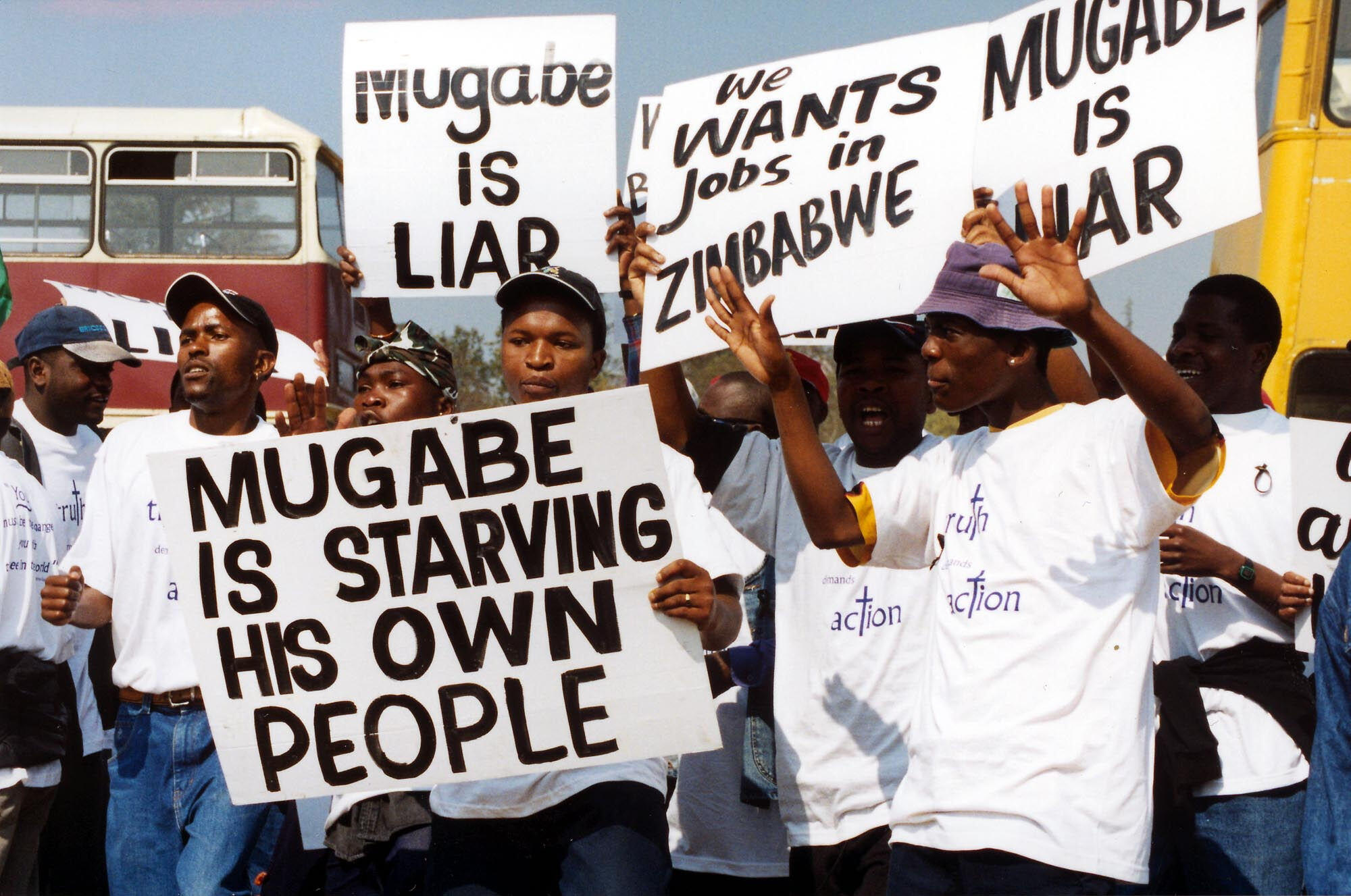
But, slow of speech and surrounded by at least half a dozen armed generals, Mugabe’s rebel spirit appears to have remained intact, and he has refused to step down despite the fact his own party no longer considers them his leader, the military has invaded his home, and thousands march in the street against him. His party has given him until midday November 20, to resign or face impeachment. The military has insisted they will not force him to resign by the barrel of a gun, and will entrust parliament to initiate impeachment proceedings (they will need a two-thirds majority to do so) when they meet on Tuesday, November 21.
~Amanda
 The Junction Journal