News Briefs
As a poet, I am often told by other people who enjoy literature that they “just don’t understand” or they “hate” poetry. I have always found this kind of baffling, since poetry takes so many shapes and forms that there is no way a person could hate all poetry.
I am always the person who goes to open mics or poetry slams and screams and cheers whenever I hear a fantastic line. If you hear a loud “Mhm!” from the back of the room, it’s probably me.
That’s why I find this study so interesting. New research supports the claim that classic narrative poems, rap music, and other forms of vocal delivery that incorporate rhythmic speech and rhyme can cause a physical reaction in individuals, which leads to the idea that our responses to this type of art may be innate.
Eugene Wassiliwizky, of the department of language and literature at the Max Planck Institute for Empirical Aesthetics, has recently led a study on poetry that was published in the journal Social Cognitive and Affective Neuroscience. To observe how poetry affects different listeners, Wassiliwizky and his team conducted two experiments. In the first experiment, the researchers monitored the heart, face, and skin hair activity of twenty-seven native German speakers as they listened to recordings of poems that they selected and believed were emotionally powerful. These poems included everything from Shakespearian sonnets to modern German poetry. All of these listeners experienced chills, and nearly a dozen even experienced goosebumps. Wassiliwizky states that that the function of goosebumps could have a beneficial effect on our ability to empathize and therefore includes both personal well-being and our ability to harmonize with a social group. Goosebumps could also be socially contagious, and that may be why the group members had that shared experience.
For the second experiments, eighteen native German speakers listen to powerful poems that they selected, but also underwent fMRI brain scans while they were listening to the poetry. During these “chill-inducing” moments, the listeners experienced activation of multiple brain regions, including the nucleus accumbent, which is the area of the brain that’s involved in processing rhythm, rewards, and in establishing and testing anticipations. Wassiliwizky states that listening to music provides different brain activation patterns.
Wassiliwizky further explains that the semantic component of poetry is as essential to these reactions as the language itself. He states, “The semantic component is essential for poetry no less than for ordinary language; this component is further amplified by the musical features of poetic language.”
Some cultures may have evolved to be more sensitive to poetry than others, which might be due to the inherent musical and rhythmic nature of particular languages and their origins. Men and women might have different reactions to poetry. The fact is that there has been little research done to explore these possibilities. However, Wassiliwizky confirms that the interest in poetry for many cultures arises with political tension, as shown in examples of German and Russian history. He explains, “Given their great potential to express and elicit strong emotions and the high memorability, poems seem to fulfill a valuable function in times of political instability, repressions and the struggle for freedom.”
Although poetry might not be everyone’s favorite, I think it is amazing that such people have such a physical response to the poems that they love. And the idea of poems gaining popularity in such times of unrest, shows that there is a power in language. That perhaps when we choose to create art that expresses how we feel, we give words to the people who have no idea what they want to say. Perhaps by giving others these words in our heart, we give them certain type of power too.
Click here for more information!
-Michelle Cherian
Every Dog Has Its Death Day: Labrador Denies That A Lack of Health Care Can Kill
We are living in a very surreal period of American history. It seems as each day passes, the news gets worse and more parodic than before. Well, it’s been a few days since Obamacare has been repealed and already politicians are making that fact clear. Just when you thought you’d heard everything, they think up something worse to say.
This past Friday morning at a town hall meeting held at Lewis-Clark State College, Idaho Representative (I’ll refrain from the obligatory potato joke) Raul Labrador (funny someone of such advanced mental capabilities would share a name with a dog breed) made some questionable statements about how mortality works. One constituent said to him, “You are mandating people on Medicaid accept dying. You are making a mandate that will kill people.” A reasonable statement, considering all of the people who will suffer under this new mandate. Guess what our dog Labrador’s response was:
“Nobody dies because they don’t have access to health care.”


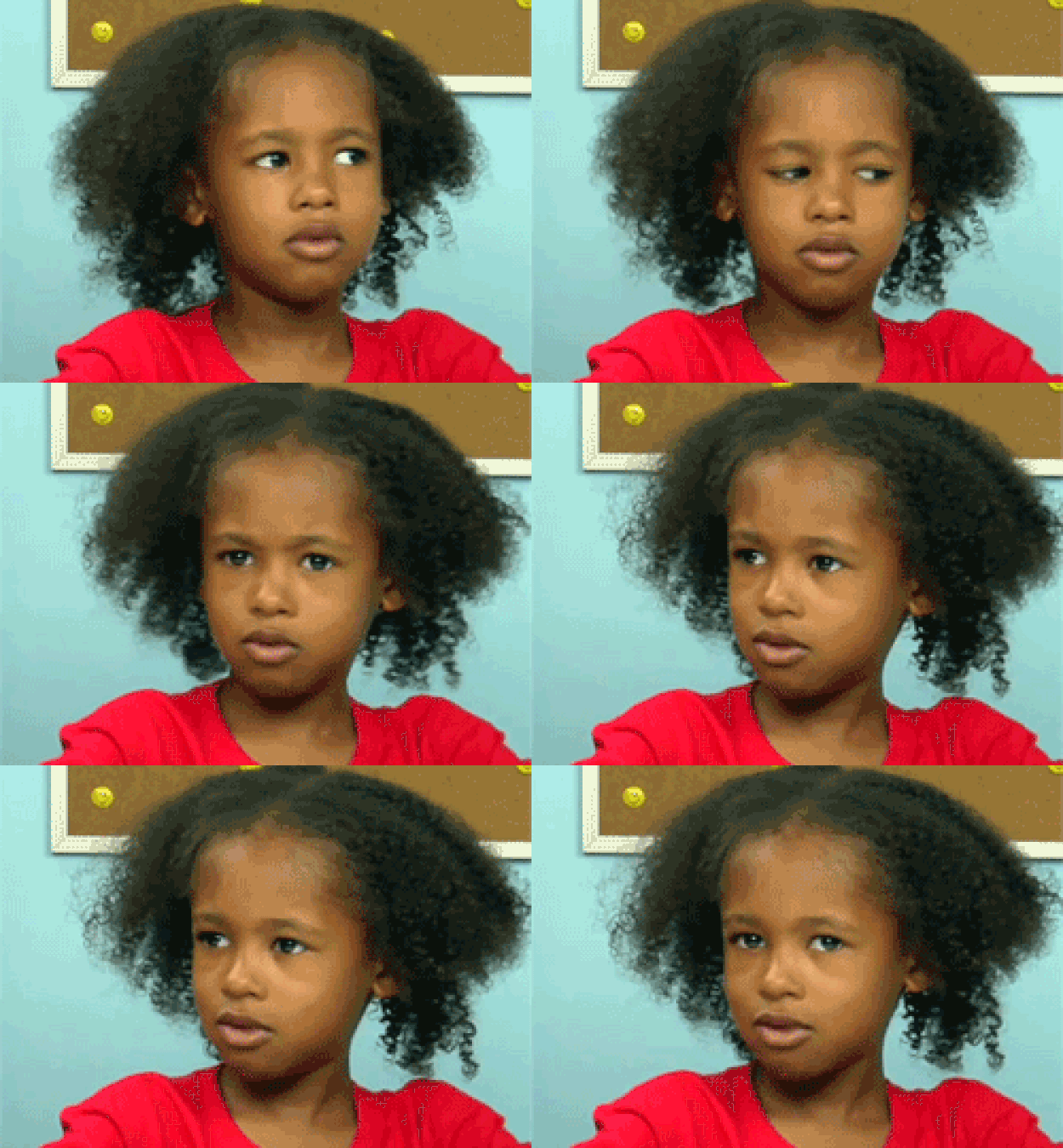

Let’s just sit with that for a moment.
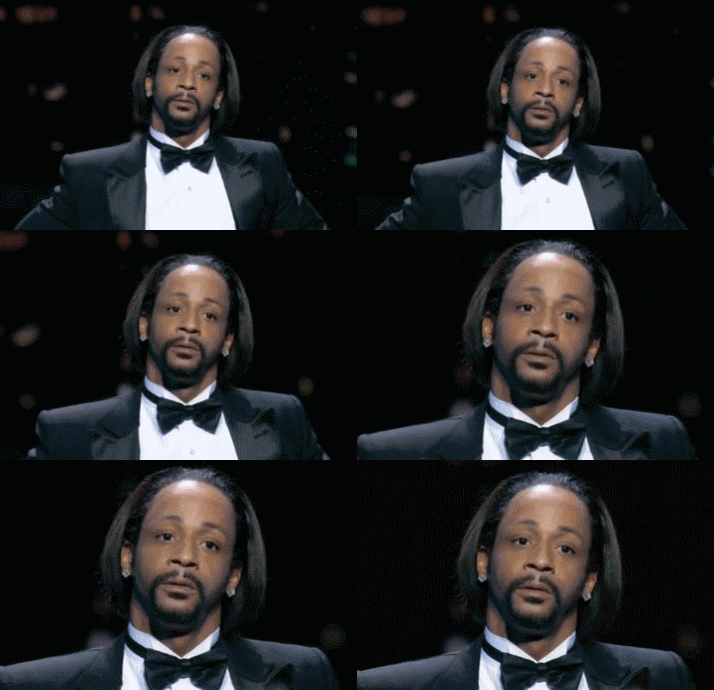
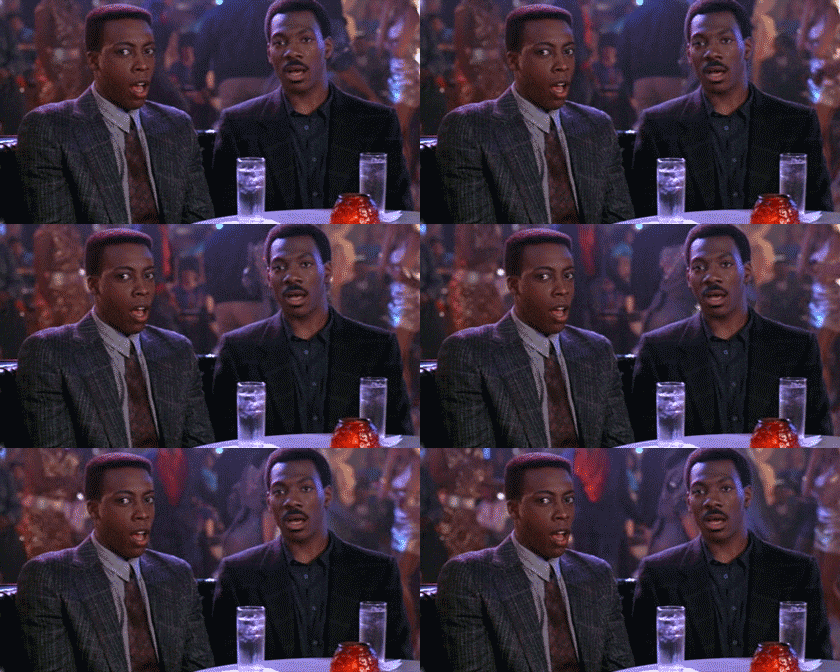


This man—no, this dog—really said in front of a group of American citizens, that no one dies due to a lack of access to health care… Is reality even a thing???

If that wasn’t bad enough, the new bill itself is no walk in the park. Apparently it will cut over $800 billion from Medicaid. The bill will also dramatically reduce federal funds for low-income citizens who need health insurance and allow states “to opt out of federal regulations, including the ban on discriminating based on preexisting conditions.”
Beautiful.
According to Huffington Post:
“It is virtually impossible to know exactly how many people would die from the GOP health care plan that the House of Representatives passed on Thursday. But prior to passage of the Affordable Care Act, the landmark law commonly known as Obamacare, some 45,000 Americans died annually due to their lack of health insurance, according to a 2009 Harvard study.”
But does anyone really need a study to understand that a lack of health care often leads to deaths? Apparently our little Idaho puppy Raul does! And there’s ample evidence that the new mandate he and his canine companions have passed will be life-threatening.
According to a new CBO report, over 24 million Americans will be denied health insurance within the first ten years of the bill:
“The CBO has reconfirmed tonight that the Republican plan will cause millions of Americans to lose their coverage and out-of-pocket costs to skyrocket, while subjecting middle-aged Americans to an age tax. They do all this to give $1 trillion in tax cuts to corporations and the wealthy, but they may not stop there,” said Rep. John Yarmuth (Ky.), the ranking Democrat on the House Budget Committee.
It seems that Republican dogs like Raul are unconcerned with who bears the real cost of their executive actions, and judging by reports, that’s a whole lot of people not to care about. Jacqueline Church Simonds, an Obamacare beneficiary told Huffington Post:
“I keep wondering why they want to kill me.”
Me, too, Jackie. Me, too.
-Isaiah Rivera
Macron Wins the French Presidency
I stayed away from the news all of this weekend because I was terrified: this past Sunday was the final vote for the next President of France.
France’s voting system is different than in the US: they vote twice, once to reveal the top two candidates, and another to choose between those two candidates. The final round this time around was between extremist right, National Front leader, Marine Le Pen and centrist, independent candidate, Emmanuel Macron. Macron won by 65.5% of the votes.
To many people (including myself) this was a true victory:

The day the current president of the United States won, I was in France. I remember that day clearly; my best friend stayed over and we decided to do an all night marathon since, due to the time change, US elections took place during the night in France. Let me continue by saying that I don’t have many American friends on Facebook, so my feed is usually very liberal with articles and posts of open minded people. France, as a whole (or, rather, as it seemed to me), did not take Trump’s candidacy seriously, often ridiculing him and speculating that there was no way he could win, that America was crazy, but not that crazy. So, when the elections came, I was positive that Clinton would win, not necessarily because of her, but because, I believed, so many more Americans were against Trump. None of my French friends saw it coming, and much less did I, when he actually won. The whole day after the elections, while my best friend and I cried, it rained. It seemed to me that the weather reflected exactly how the world was feeling: downcast.
I remember clearly the following weeks in which Marine Le Pen, who had made racist remarks and attacked immigrants for France’s economic problems, who was also being ridiculed by the media, from day to night became a real threat to be taken seriously. Now that Trump had won, now that Brexit was really happening, so could the French elect a far right, xenophobic, candidate.
Luckily, Macron won. And I literally mean luckily. He is young, never ran for office before, and does not belong to any of France’s major political parties. The odds were certainly against him.
His victory comes after a bitter campaign with Le Pen in which she accused him of being part of an elite that did not understand ordinary people and he said Le Pen represented the “party of hatred” that wanted a “civil war” in France. The runoff pitted France’s most Europhile candidate against its most Europhobe.
While Macron won, it’s still important to recognize that a lot of French people were prepared to elect a far right candidate who denied French responsibility for the fatal deportation of 13 000 Jews during the Second World War (source).
Political scientists have warned that no one should write off the French far right after Marine Le Pen’s presidential loss. The Front National has slowly been gaining ground for the last 45 years and its steady electoral increases must be seen in the long term. The issues that the party has sought to focus on and capitalise from – the terrorist threat, the refugee crisis, immigration, mass unemployment, deindustrialisation, voters who struggle to make ends meet – are unlikely to instantly disappear.
The rise of the far right in France to unprecedented levels of popularity is like the relative triumphs of the far right in contests in Austria and the Netherlands; it points to a deep malaise in European and particularly French politics. The French are deeply pessimistic and a glance at the unemployment figures and life in the banlieues explains why. Social dislocation, radicalisation, racism, terror and the rise of extremism can, at least in part, be traced back to the long stagnation of the French economy. The EU and the unsolved weaknesses in the euro system must also share in the blame for a near political cataclysm.
Elsewhere in Eastern Europe, notably in Hungary and Poland, a nasty strain of authoritarianism is taking hold. More widely still, from Trump to Erdogan and from Putin and Modi to Xi, and now also in Britain, hard nationalism is hardly in retreat.
For now, France has chosen hope over hatred.
Macron has a lot of challenges facing him. Only time will tell what will happen to the future of France and the world. It is important to note, that there will always be resistance. As there is now in the United States, so I hope there will be in France and the rest of the world if the threat of far-right nationalism prevails.
-Alana
 The Junction Journal