

The “Appalling Strangeness of God”
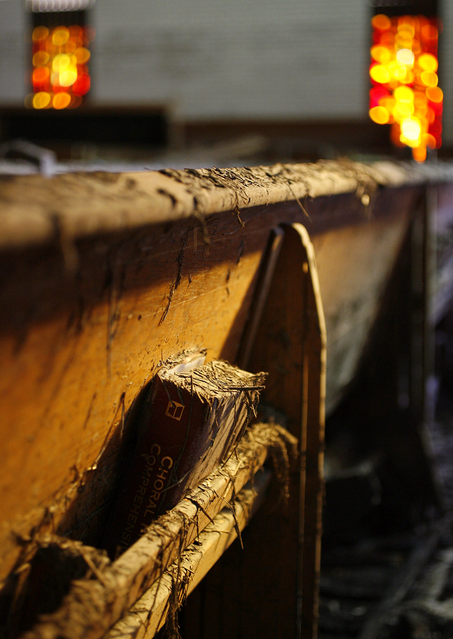
This planet of ours seems to want to get us the hell off its surface. When the word “super” preceding “storm,” “hurricane,” “tornado,” etc. is ubiquitous, there is a problem. The Philippines and the midwest both vie for headlines bedecked with wanton destruction. Pictures of houses torn apart by wind and water could be either in a island nation in the pacific or in the American heartland.
“You cannot conceive, nor can I, of the appalling strangeness of god,” said Graham Greene. God and natural disaster go hand in hand in the typical news lexicon. Fifty tornados spotted in one storm system is, for local news and insurance companies, “an act of god.” The god-discourse helps to explain, in part, how so many people in this country refuse to believe in the science of climate change. Yes, they say, the climate may be changing, but it is hubris to believe that man has the power to change it. Thus, climate change becomes a part of His plan; Yolanda, Sandy, the nameless mass of tornados and floods either benevolent through some twist of fate or punishment for some imagined slight. These are the same people who believe that the paralyzed are being punished for their sins. The terminally ill suffering before God’s benevolence.
-Maegan Ciolino
The Benefit and Loss of Free Literature
Google just won a long-running lawsuit over its plan to scan and index all the world’s books. Just another stepping stone in the company’s obvious and ultimate plan to take over the entire world, and possibly universe. Judge Denny Chin, the New York Federal Court judge presiding over a lawsuit of eight years finally ruled in favor of Google in deciding whether Google’s display of snippets of books was allowed under the provisions that allow limited use of copyrighted material. He further ruled that “all society benefits” from book scanning, from librarians to researchers who have begun to rely on the internet search as an essential tool. He mentioned that “in this day and age of online shopping, there can be no doubt that Google Books improves book sales.”

There is a more serious question being asked here. In an age of Internet, one that is no longer new but one that has now been inculcated into our lives, our libraries, and schools, where does one draw the line dividing author’s rights and this new right of unlimited access to information? In earlier ages, books, learning, and information were privileges for those who could afford tutors and printing. With Ben Franklin’s revolutionary idea of a library came the idea of free and public information. Later, the invention of the World Wide Web demonstrated an easier and more comprehensive way of learning. Now, growing up with information literally at our keyboard-tapping fingertips there is an air of entitlement attached. Does the public have the authority to demand access to resources? Or, is this widespread learning just a greater extension of Franklin’s vision to extend a hand to the public? If I can’t afford a book, can I read it online?
-Rebecca Najjar
The North Korea Massacres
This morning while going about my daily routine of checking emails, this stellar example of current events popped up in my yahoo news feed:
The Hair-ocracy! Is Justin Bieber Bald?
I almost choked on my cereal.
Meanwhile, in other news, North Korea publicly executed eighty of its citizens for crimes of watching South Korean films, cell phone usage, and owning a bible. In cities throughout the country, these criminals were herded into stadiums and murdered in front of tens of thousands of their countrymen.
 About a year ago, I went to the theater with my husband to see the first Hunger Games movie. After it was over, I asked him what he’d thought of it. He replied, that it was hard to believe that such a society, which annually kills its own children, could exist.
Um, North Korea?
What infuriates me more is that we so often hear about North Korea’s development of nuclear weaponry, while setting aside the issue of the widespread persecution of its people. I recently read, how cannibalism is runs rampant in the streets, because the people are starving. I have read that during the Roman siege of Jerusalem, men and women ate their own children to survive. And at the time, I found it hard to believe. But it is happening today, in this country across the Pacific.
And I want to know what we are going to do about it.
-Ariella Shapiro
North Korean excecutions
Bieber
 The Junction Journal